Uncategorized
CG Emotron VSS Series AC Drives: Complete Guide to Features, Specifications & Programming
CG Emotron VSS Series AC Drives: Complete Guide to Features, Specifications & Programming
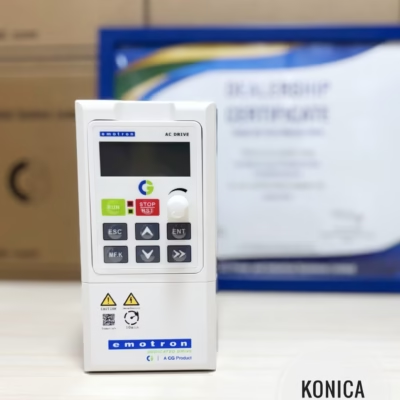
⚡ The VSS series from CG Emotron (CG Drives & Automation) is a compact, feature-rich AC drive built specifically for single-phase supply systems — and it can run three-phase motors straight off a single-phase 220V line. It’s ideal for packaging machines, wood-working equipment, pumps, blowers, mixers, conveyors and printing machinery. This guide covers everything from decoding the model number to wiring the drive and getting it running from the keypad.
💡 Main Features
✅ Can be used with a single-phase supply to run three-phase motors
✅ Various master & auxiliary command sources with switchover
✅ Flexible fan control
✅ Field-weakening control
✅ Process PID control, simple PLC, and 16-step speed control — all programmable
✅ Wobble frequency control
✅ Multi-functional key, programmable
✅ Programmable overvoltage and under-voltage protection
✅ V/f separated control, with torque control at sensor-less vector control
📋 Understanding the VSS Model Number
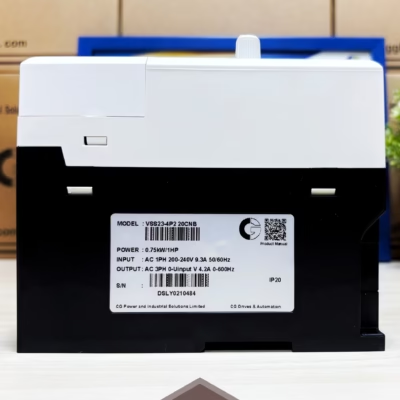
Every VSS drive’s nameplate encodes its specification in the model number. Here’s how VSS23-2p5-20CEB breaks down:
| Code Position | Meaning |
|---|---|
| VSS | Product series — VSS = Single-phase drive |
| 23 | Input AC voltage level — 180–240V AC / 340V DC |
| 2p5 / 4p2 / 7p5 / 9p5 | Rated current code (A) — e.g. 2p5 = 2.5A, 9p5 = 9.5A |
| 20 | Protection class — IP20 |
| C | Control panel — C = Standard panel |
| N / E | EMC filter — N = No filter, E = EMC filter fitted |
| B / – | Brake chopper — B = Brake chopper fitted, – = without |
💡 A ‘-XS’ suffix on the model number denotes a drive with a 7-segment LCD display.
⚖️ Available Models & Ratings (1-phase, 220V)
| Model No. | Power (kVA) | Input Current (A) | Output Current (A) | Motor (kW / HP) |
|---|---|---|---|---|
| VSS23-2p5-20CEB | 1.0 | 6.5 | 2.5 | 0.37 / 0.4 kW — 0.5 HP |
| VSS23-4p2-20CEB | 1.5 | 9.3 | 4.2 | 0.75 kW — 1.0 HP |
| VSS23-7p5-20CEB | 3.0 | 15.7 | 7.5 | 1.5 kW — 2.0 HP |
| VSS23-9p5-20CEB | 4.0 | 24 | 9.5 | 2.2 kW — 3.0 HP |
🔧 Technical Specifications
| Rated input voltage | 1-phase 220V (−20% ~ +20%) |
| Rated input frequency | 50Hz / 60Hz, tolerance ±5% |
| Maximum output voltage | 0 ~ rated input voltage, error < ±3% |
| Maximum output frequency | 0 ~ 600Hz, resolution 0.01Hz |
| Control modes | V/f control, Sensor-less vector control 1 & 2 |
| Speed range | 1:50 (V/f) · 1:100 (SVC1) · 1:200 (SVC2) |
| Speed accuracy | ±0.5% (V/f) · ±0.2% (SVC1 & 2) |
| Speed fluctuation | ±0.3% (SVC1 & 2) |
| Torque response | < 10ms (SVC1 & 2) |
| Starting torque | 180% at 0.5Hz (V/f & SVC1) · 180% at 0.25Hz (SVC2) |
| Overload capability | 150% for 60s · 180% for 10s · 200% for 1s |
| Protection functions | Overcurrent, overvoltage, undervoltage, over-temperature, overload |
| Ambient temperature | −10°C ~ 50°C |
| Altitude | 0 ~ 2000m (derate 1% per 100m above 1000m) |
| Relative humidity | 5% ~ 95%, no condensation |
| Efficiency | ≥ 93% at rated power |
| Installation | Wall-mounted or flange mounting |
| Cooling | Fan cooled |
🔌 Wiring the VSS Drive
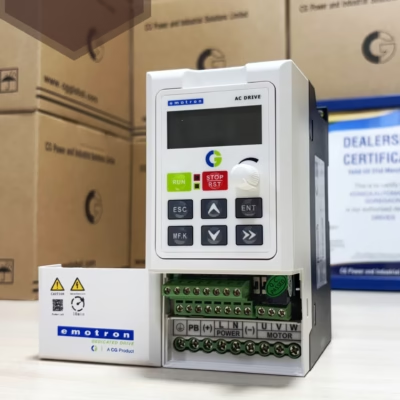
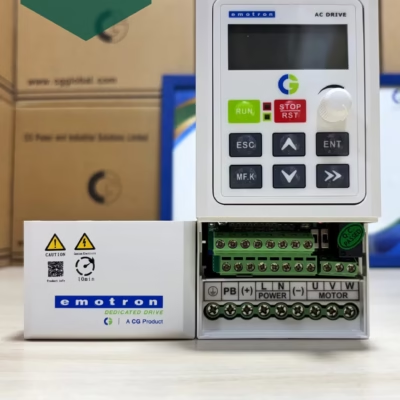
The VSS (0.4–2.2kW) drive takes a single-phase supply on the input side and still outputs a full 3-phase drive signal to the motor. Getting the wiring right is the first step in programming — the drive can only be configured once it’s powered and the right signals reach the right terminals.
Main power & motor circuit
✅ L, N — single-phase 220V, 50/60Hz supply, through an MCCB
✅ U, V, W — 3-phase output to the motor
✅ Earth (⎓) — motor and drive frame earthing
✅ (−), (+), PB — external braking resistor connection
Control terminals
| Terminal | Type | Function |
|---|---|---|
| DI1–DI4 | Digital input | 4 programmable switch inputs — run/stop, direction, preset speeds, etc. Impedance 2.4kΩ, level input 9–30V |
| DI7/HI | Digital / pulse input | High-speed pulse input, max 200Hz (100kHz for DI7) |
| AI1, AI2 | Analog input | DC 0–10V or 0–20mA reference signal — typically a speed potentiometer (1k–5kΩ) on AI1, with a voltage/current switch on AI2 |
| AO1 | Analog output | DC 0–10V or 0–20mA output, e.g. to drive a remote frequency meter |
| Y1 | Digital output | Open-collector output 1, 0–24V / 0–50mA |
| R1A / R1B / R1C | Relay output | Changeover relay contact, 250V AC/3A (cosΦ=0.4) or 30V DC/1A — commonly wired to a fault indicator or contactor |
| 485+, 485− | RS485 | Modbus communication, 4800–115200 bps — for PLC/SCADA integration |
| +24V, +10V, GND, PE | Power/reference | Onboard supply rails for external switches and the analog reference potentiometer |
⚠️ Always wire and check connections with the drive fully powered down and the DC bus capacitors discharged. Route control wiring separately from the motor power cable to avoid electrical noise affecting the analog signals.
💻 Programming & Commissioning the VSS Drive
There are two ways to configure a VSS drive: the built-in keypad, or CG’s free EmoWizard PC software.
Using the keypad
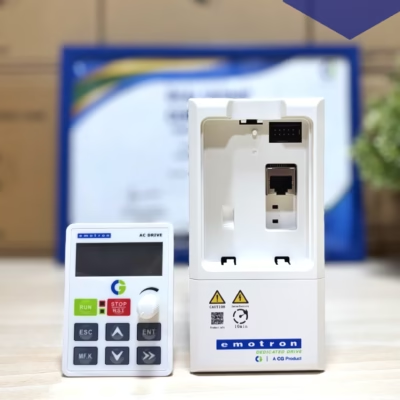
The standard control panel has a display plus 7 buttons:
▶️ RUN — starts the motor
⏹️ STOP/RST — stops the motor, or resets the drive after a fault
↩️ ESC — exits a menu or cancels an edit
✅ ENT — enters a menu, or confirms an edited value
🔄 MF.K — multi-function key (its action is configurable)
⬆️⬇️ Up / Down arrows — scroll through menus, parameters and digits, or jog the frequency reference up and down
▶▶ >> — shifts which digit you’re editing, or scrolls display pages
💡 Typical first-run sequence: power up the drive from the single-phase 220V supply → confirm the display shows a frequency (e.g. 50.00Hz) → use ESC/ENT and the arrow keys to navigate into the parameter menu and set the motor nameplate data (rated voltage, current, frequency, poles) → set the command source (keypad, terminal, or RS485) and the frequency reference source to match your wiring → press RUN to test rotation direction at a low frequency, then bring it up to speed with the Up/Down keys.
Using EmoWizard software
For faster commissioning and troubleshooting, CG’s EmoWizard software connects to the drive over USB/RS485 and gives you:
✅ A graphical control panel to start/stop and adjust speed from a PC
✅ A built-in oscilloscope to plot live drive statistics while tuning
✅ Full parameter read/write and comparison, so a working configuration can be saved and copied to other drives
✅ Real-time fault diagnostics
🧩 Accessories
| Accessory | Part No. | Description |
|---|---|---|
| Keypad – basic | PPU-VSmicro | LED display, RJ45 connection |
| Keypad – standard | S-PPU-VSmicro | LCD display, RJ45 connection |
| Profibus card | VSPROFIBUS-DP | Profibus communication card, DB9 connection |
🏭 Typical Applications
✅ Conveyors — material handling and packaging lines
✅ Packaging machines — carton, wrapping and filling equipment
✅ Printing machines — label and package printing lines
✅ Cheese winders and other textile/finishing machinery
✅ Pumps, blowers & mixers — anywhere only a single-phase supply is available
✅ Wood-working equipment — saws, planers and general workshop machinery
❓ Frequently Asked Questions
What makes the VSS series different from CG Emotron’s other drives?
✅ The VSS runs on a single-phase 220V supply, but its output still drives a standard 3-phase motor — ideal for sites or machines where only single-phase power is available.
Does the VSS support PID and PLC-style control?
✅ Yes — it has built-in process PID control, a simple PLC function, and 16-step programmable speed control, all configurable from the keypad or EmoWizard.
Can the VSS drive be controlled from a PLC or SCADA system?
✅ Yes — via the RS485 (Modbus) port, or through the digital and analog I/O terminals for simple run/stop and speed reference control. A Profibus-DP card is also available as an accessory.
What’s the difference between the LED and LCD keypad options?
💡 The basic PPU-VSmicro keypad has a simple LED display, while the S-PPU-VSmicro standard keypad has a full LCD display for easier parameter navigation. Both connect via RJ45.
🛒 Shop the CG Emotron VSS Series
🚀 These VSS models are in stock and ready to ship:
VSS23-2P5-20CEB — 0.25kW / 0.5HP
VSS23-4P2-20CEB — 0.75kW / 1HP
VSS23-7P5-20CEB — 1.5kW / 2HP